
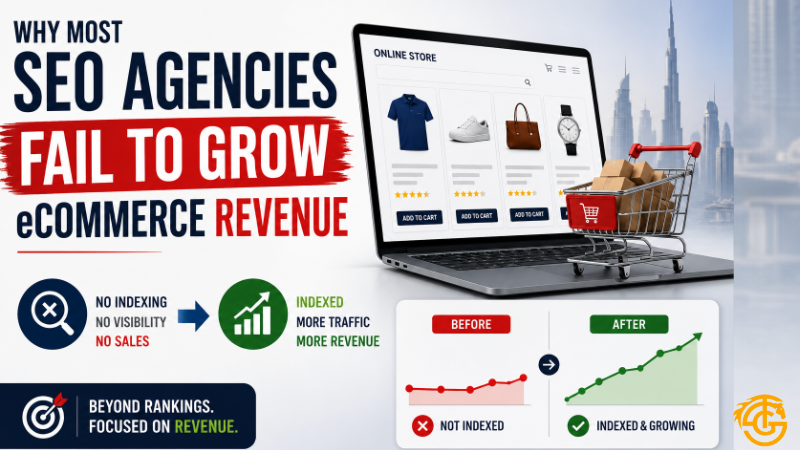
Why Most SEO Agencies Fail to Grow eCommerce Revenue
Running an eCommerce business today is more competitive than ever. Thousands of online stores are competing for visibility, clicks, and conversions. As a business owner, your ultimate goal isn’t just more traffic—it’s more sales.
When revenue slows down, many businesses invest in SEO, expecting higher rankings to translate into increased revenue. Unfortunately, months later, they’re still asking the same question:
“Why isn’t my eCommerce store generating more sales?”
The answer often isn’t your products.
It isn’t your website design.
And it isn’t even your marketing budget.
The problem usually begins much deeper—inside your website’s technical foundation.
One of the most overlooked aspects of eCommerce SEO is Google Indexing.
If Google cannot discover and index your products, those pages simply cannot rank. And if they don’t rank, they cannot generate organic traffic or sales.
Before Chasing Rankings, Ask This One Question!
Are your products actually indexed by Google?
Many business owners never ask this question because they assume every published product automatically appears in Google Search.
That assumption is wrong.
Thousands—even tens of thousands—of product pages remain undiscovered by Google because of technical SEO issues.
Your SEO agency may proudly report:
- Higher keyword rankings
- More backlinks
- Improved domain authority
- Monthly SEO reports
Yet your sales remain unchanged.
Why?
Because Google never indexed many of your revenue-generating pages.
Before & After: A Real Example of Google Indexing
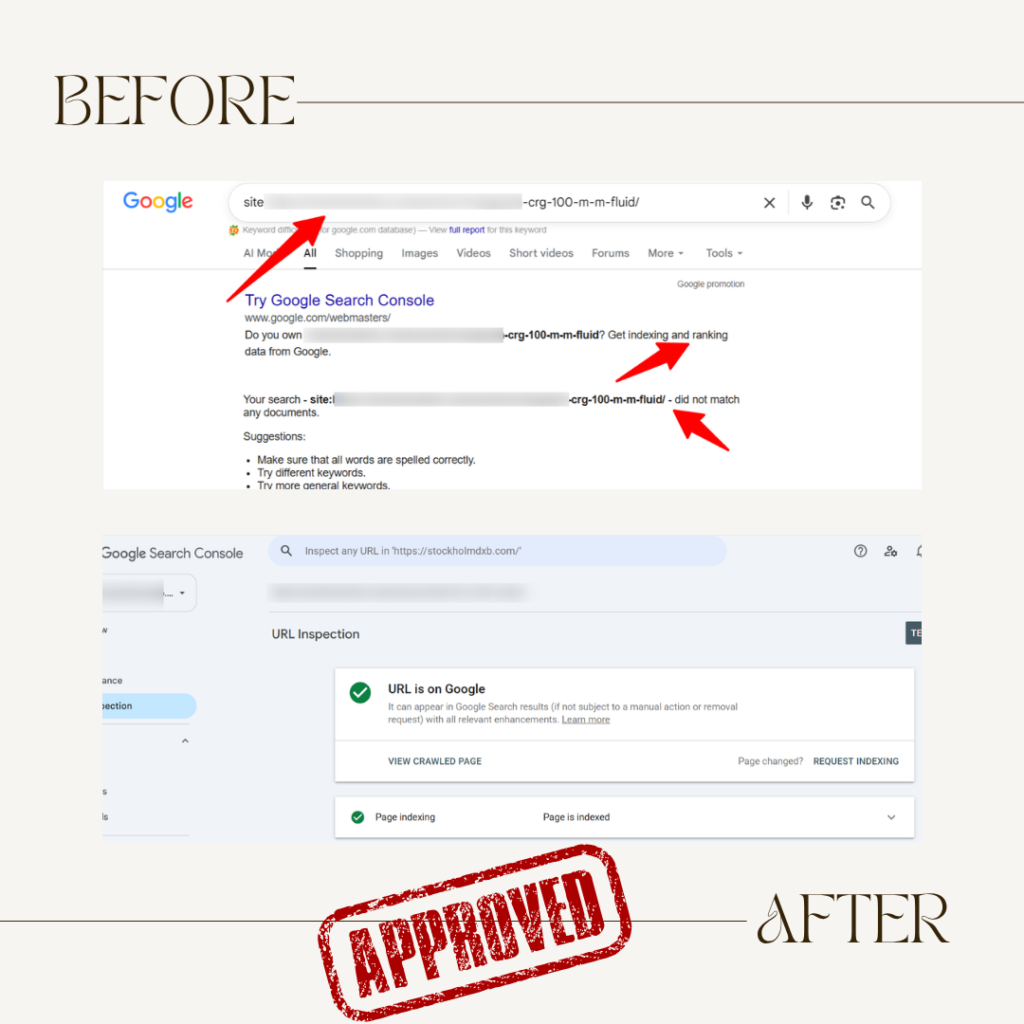
For one of our UAE Ecommerce Store, Before fixing indexing issues, the product page wasn’t appearing in Google SERP. After resolving the technical SEO problems and submitting the page correctly through Google Search Console, the page became eligible for indexing and search visibility.
This simple change transformed an invisible product page into one that Google could finally crawl, understand, and rank.
The Biggest Mistake Most SEO Agencies Make
Many SEO agencies start with:
- Keywords
- Content writing
- Link building
- Blog publishing
Those strategies matter. But they assume Google can already crawl and index your website. For large eCommerce stores, that assumption is often false.
Technical SEO should always come first.
Google Can’t Rank What It Can’t Index
Think of Google as a massive library. Every product page is like a book. If the book never reaches the library shelf, nobody can borrow it.
Your product page may be beautifully designed. It may have excellent descriptions. It may even be faster than competitors.
But if Google hasn’t indexed it, customers will never find it through search.
- No visibility.
- No clicks.
- No sales.
Why Large eCommerce Stores Struggle More
The larger your store becomes, the more difficult indexing becomes.
A website with 200 products behaves very differently from one with 20,000 products.
Large stores commonly experience:
- Duplicate product pages
- Faceted navigation
- Filter URLs
- Parameter URLs
- Thin product content
- Pagination issues
- Orphan pages
- Broken internal links
- Crawl waste
Google has limited resources. It doesn’t crawl every page equally.
This introduces another critical concept: Crawl Budget We will discuss this in next article!
Why Rankings Alone Don’t Increase Revenue
Many agencies celebrate ranking improvements.
But ranking one blog post for an informational keyword doesn’t necessarily sell products.
Revenue comes from product visibility.
Your product pages should be:
- Crawled
- Indexed
- Properly categorised
- Internally linked
- Optimised for search intent
Only then can they compete in Google Shopping and organic search results.
What We Prioritise at SGT Infotech
At SGT Infotech, we believe SEO starts long before keyword optimization.
Our process begins by asking:
- Can Google properly crawl your website?
- Can Google discover every important product?
- Can Google efficiently use its crawl budget?
Only after answering these questions do we optimize:
- Product pages
- Categories
- Metadata
- Content
- Internal linking
- User experience
- Authority signals
Because sustainable SEO growth starts with a technically healthy website.
SEO Is More Than Rankings
Many businesses believe SEO means: “Add keywords.”
But, real SEO is far more complex.
Successful eCommerce SEO combines:
- Technical SEO
- Google Indexing
- Crawl Budget Optimisation
- Site Architecture
- Internal Linking
- Product Optimisation
- User Experience
- Structured Data
- Page Speed
- Content Strategy
Miss one of these foundations, and your growth slows.
How to Check If Your Products Are Indexed
You can quickly check by searching Google: site:yourdomain.com/product-name
If no results appear, that product may not be indexed.
You can also verify individual URLs using Google Search Console’s URL Inspection Tool to see whether Google has indexed the page or identify any issues preventing it from appearing in search.
Final Thoughts
Most eCommerce SEO campaigns fail not because businesses have poor products, but because they build their strategy on an unstable technical foundation.
If Google cannot crawl your website efficiently, it cannot index your products.
If your products aren’t indexed, they won’t rank.
And if they don’t rank, they won’t generate organic sales.
Before investing more in content, backlinks, or advertising, make sure your products are visible to Google.
Because in eCommerce, visibility is the first step towards revenue.
At SGT Infotech, we help businesses across Canada, USA, UK, AU, NZ, UAE, and globally solve complex technical SEO challenges—from crawl budget optimisation and Google indexing to scalable eCommerce SEO strategies that support long-term growth.
Frequently Asked Questions
Traffic alone doesn’t guarantee revenue. If high-intent product pages aren’t properly indexed or optimised for commercial searches, visitors may not reach the products they’re looking for.
Google indexing is the process of storing and organising your web pages in Google’s search database. Only indexed pages are eligible to appear in search results.
Google can index new product pages within a few days to several weeks, depending on your website’s crawl budget, authority, internal linking, sitemap quality, and technical SEO. Submitting URLs through Google Search Console may speed up the process, but it does not guarantee indexing.
Product pages may not be indexed due to duplicate content, poor internal linking, incorrect canonical tags, noindex directives, crawl budget issues, or other technical SEO problems. Resolving these issues improves search visibility.
Yes. Better indexing helps more product pages become eligible to appear in Google Search. When high-intent product pages are indexed and ranked, your store has a greater opportunity to attract qualified organic traffic, which can contribute to increased enquiries and sales over time.
